
Problems of the theory of evolution
This area of science, the most evil and zealously guarding its achievements. For everyone who dares to criticize something in it, a flood of rage, accusations of creationism, belonging to an "alternative science", pseudoscience falls. It already more and more resembles religion, assuring that it is fully proven, and therefore it must not be touched! Unfortunately, this only seems to be because the vast majority of people believe in these conclusions without trying to figure it out thoughtfully. If anyone encounters doubts at the first meeting, then a powerful stream of propaganda that brings “irrefutable evidence” rains down on him. And that’s it, ready-made blockhead.
Meanwhile, not even the most careful consideration leads to the fact that serious gaps become visible, and this opinion is then persistently not dispelled. Not everything is proved! No, I do not at all affirm that all species on planet Earth were created by a single creator at one moment in time. Of course, all species came from one another, and you can even build a clear sequence, as it roughly happened. What evolutionists did, considering their work done. I do not argue with that. Therefore, I am also an evolutionist, not a creationist. But here is how this process happened, sometimes it looks completely absurd, and against logic and common sense. And all attempts to build a theory of what the stages were in these events sometimes reminiscent of not even pulling cowards on the ears and owls on the globe, but, directly, acrobatic tricks in the circus. The fact is that if in the world of viruses and bacteria, protozoa is more or less clear, then for complex living things, such as higher animals, it is not so clear. Evolutionists cite several driving factors of evolution, the main of which are random mutations and natural selection. So, in many cases, it begins to stubbornly seem to us that these factors are clearly not enough, and a feeling is created that someone intervened in the course of evolution. Especially when it comes to large-scale changes in higher organisms, called idioadaptation and aromorphosis.
As is known, the main criteria for the scientific nature of knowledge are two:
- Verifiability, scientific knowledge can be repeated.
- Falsifiability, scientific knowledge can be refuted.
So, the modern theory of evolution cannot be refuted! You'll be killed for trying. The theory of evolution is absolutely correct, and that's it, everyone shut up! Anyone who tries to criticize it will receive, at best, a reluctance to talk from so-called scientists, but it can also lead to outright rudeness and even threats. This happened to me with one biologist who was the first to contact me and initially seemed liberal-minded.
Thus, the modern theory of evolution is not scientific knowledge.
Proofs of the modern synthetic theory of evolution are typically based on demagoguery. They actively use: misrepresenting effect as cause (look at the result, and the theory of evolution is correct, or millions of years have passed and this is how it happened), misrepresenting correlation as cause (if it's true in one case, it's always true), and substituting the thesis (if it works in the world of simple organisms, it will also work in the world of higher organisms).
No matter how hard evolutionists try to find an "intermediate link," they always end up with leaps that immediately raise serious doubts. It turns out that evolution moved not in steps, but in leaps.
Let's take the most famous example, the evolution of the eye. It's considered proof number zero. We're shown several varieties of eyes known in nature, and they say, look, this is what came out of this. Step by step. One, two, three, four, five.
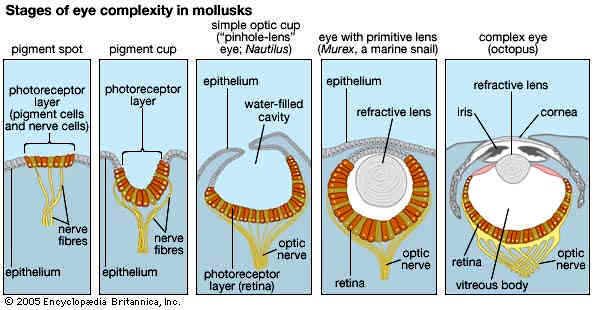
But even a simple critical approach shows that it won't work that easily! At any of the intermediate stages of the transition from one species to another, a complex transformation would be required, and the eye would be nonfunctional at that point, meaning the living creature would be unable to see. Therefore, such evolution is simply physically impossible.
I will not disclose my comments in detail here, it will turn out very long and tedious, I will give just a few examples. Let's start with the theory of abiogenesis, that is, the spontaneous emergence of life. Its supporters are reproached for relying on the random nature of the events that happened, and it is incredibly annoying for them. They do not succeed in the process that would lead to the emergence of self-reproducing DNA. A protein catalyst is required for this process. This is a complex organic compound, in fact, a program of replication of organic molecules, which could not have arisen by itself for no reason. Especially in a large body of water, such as the ocean. A lot of experiments were carried out, in the end they came to the conclusion that RNA molecules had to arise first. It has become a little easier, because they also need to replicate! Using the same protein. Finally, the last discovery, which was to finally shed light on this moment, self-replicating RNA molecules. Alas, there is a problem. The section of their code must contain the same catalyst protein. It is simply embedded in the molecule itself. And again, he could not arise just like that, on his own. As a result, a kind of despondency arose in the scientific community when we were told that life on Earth is a unique phenomenon that arose as a result of a chain of happy coincidences. And nowhere else in the universe could this happen anymore. We are alone with our uniqueness, and that’s it. Well, you yourself understand. Or the moon helped with its tides, the whole thing in the moon.
We will skip the world of protozoa and insects, we will pass to the classic example - the release of animals from water to land. It is considered fully proven. At first, the fins of the fish turned into legs, and these creatures began to move along the bottom in shallow water. Sometimes get out on land. Then their scales disappeared, and they turned into double-breathing. Those eventually settled on land and became the ancestors of dinosaurs.
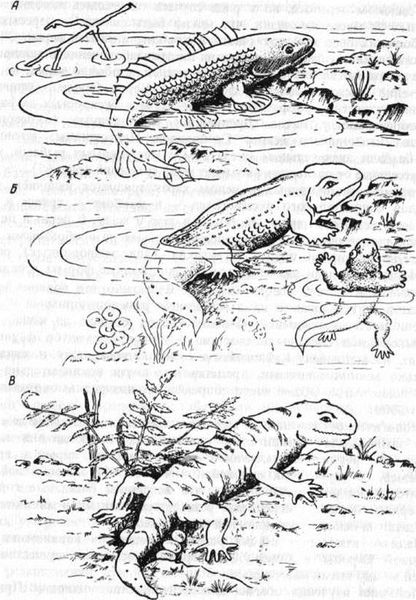
I will not argue with that. Maybe it was. But then strange things begin that are usually not mentioned anywhere. The dinosaurs mysteriously again appeared scales. Then they repeatedly returned to live in water, then left it back to land. And so, evolution began to write out epic zigzags that amaze the imagination.
On the question of how birds formed from dinosaurs and how they learned to fly, biologists have no consensus. Either they ran downhill from them, waving their front paws, then they jumped off a cliff like kamikaze, or they jumped from trees, also risking breaking. And each time it happened very interestingly. The front legs started instead of clinging to tree branches, turning to the sides and taxiing in jumps. Two feathers grew on them, which significantly improved aerodynamic characteristics. Further forward paws became longer for some reason, and they could already wave. Such a "bird", however, in my opinion, could not climb a tree, and could not really fly. That is, in fact, nothing could. A typical weak link in the idio-adaptation chain. But what ambitions! I’ll fly, no matter what, and that's it! Here is one of the last options for such an evolution:
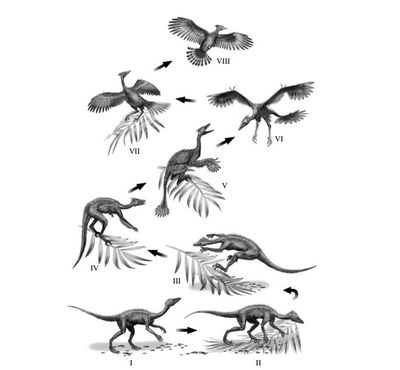
Little dinosaurs ran through the forest on their hind legs, then they had a modification of their hind legs, and they began to jump onto the lower branches of trees, from branch to branch, the front legs began to lengthen for some reason, instead of helping to jump. Further, the feather industry, and now, an almost finished bird! Learn a little fly! So far there is nothing to wave, but it doesn’t matter. In addition, I am very interested in what kind of trees are depicted? Some ferns, and very conditional. If these trees had branches to the very ground, and with such dense foliage, most likely, among them there wasn’t much to jump. And if the bare branches that we can see in modern breeds, then they are usually high off the ground. Against the claims of the authors of this concept, a small dinosaur hardly knew how to jump high. Even less understood is his motivation in the desire to jump from branches, and learn to fly, spreading his front legs to the sides, instead of at least grabbing their prey. Yes, birds in flight grab prey with their hind legs, but dinosaurs running on their hind legs, as I understand it, had no such habit. And it hurts to fall from a tree; desire may disappear after the first attempt. No matter how many scientists build their hypotheses, they still cannot convincingly draw this process in stages. It turns out all the same, either completely ridiculous, or noticeable inconsistencies are immediately visible. At the same time, they, it seems to me, do not see the essence: at first, modifications to the future transformation into birds began with completely terrestrial flightless dinosaurs. Scales began to turn into feathers, mouth to beak, and internal organs began to transform. Meanwhile, convincing arguments in favor of how the plumage appeared, and why the beak was better than the mouth, is not given. Moreover, this happened in different species, some appeared feathers, in others beaks. It was as if someone was experimenting then or the dinosaurs themselves were reasonably preparing to become birds.
For a long time they could not solve the riddle of how the whales appeared. Finally, she was guessed! From terrestrial ungulate mammals. The victory of evolution! But ... how could this happen? Obviously, just like that. First, the animal began to go into shallow reservoirs, then swam, then it became completely swimming, then it began to go out into the ocean a little bit, there the hooves turned into fins, the breathing hole went to the back of the head, and in general, the food completely changed, instead of grass or small animals - sea crustaceans or even fish. Well, a big ship has a great voyage!
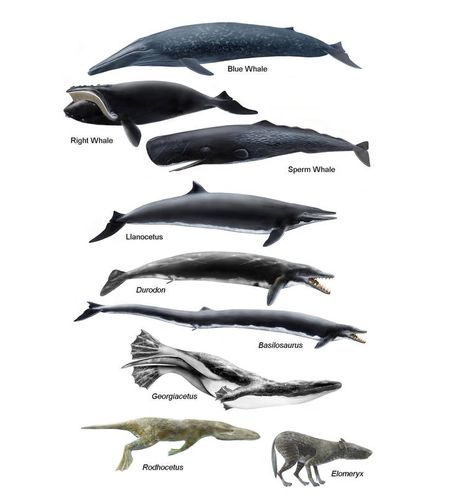
Seems quite strange? And rightly so, do not look there. This confuses evolutionists.
And there are a lot of such examples. No one knows how and why the zebra became striped. They tried to explain by the fact that supposedly she was disguised from the tsetse fly, hiding in the interference, it was not confirmed. And this explanation does not provide an answer to the question of how the bands were originally formed in general.
Sometimes, in an attempt to explain how certain species came to another continent, amusing theories are given. For example, that in ancient times monkeys sailed from Europe to America across the ocean on ... rafts. These are the ancient shipbuilders. Actually, this idea initially looked like this: trees fell with a brood of monkeys into the river, and sailed on it into the ocean, and then to America in direct motion, like an oceanic intercontinental ship! Brave sailors supposedly survived, eating the leaves of a floating tree. Not only were they threatened by storms and hurricanes. They had absolutely no fresh water. Yes, and they would have died, it seems to me, in a few days from fear. But who pays attention to such nuances? What is the depth of the idea!
There is one more objection to the main driving factors of evolution. The more complex organisms, the more they become resistant to mutations. There is even a repair mechanism that repairs damaged DNA. Species themselves begin to resist sharp jumps. To make a breakthrough, and aromorphosis or idioadaptation, that is, a serious modification, turned out, millions of attempts are needed for one successful mutation, each small step. But we do not see them, these millions of mutants! On the contrary, rare mutants are most often unviable. Complex species are more or less resistant to major changes. The color of the plumage or the size of the individual may change, the possibility of mating between branches may disappear, but something fundamentally new should not be obtained like this. Here, the laws that worked well at the level of microbes and protozoa cease to act.
Well, the crown of all evolution is anthropogenesis. Now it’s not completely clear how the modern man has developed. Why did he have bipedalism, upright posture, hairline disappeared. There are two dominant theories of all this, "savannah" and "aquatic", but both do not give a full answer. Moreover, if earlier anthropologists gave a clear picture of how homo sapiens appeared, now they are at a loss to tell from what exact ancestor he came from. It seems that, it turns out, he came from many at once. We are not direct descendants of Australopithecus, Pithecanthropus, Neanderthal, and other hominids, these are just branches. Our immediate ancestor is unknown to science! Moreover, which is strange, the remaining branches all died out. Among other bottlenecks in theories of anthropogenesis, there is one significant objection that is usually overlooked. Do you like this creature?
What kind of houses did our distant ancestors live in? Caves? Caves are few, and it's easy to die in them from the cold and dangerous animals. Building adobe houses back then would have been unlikely; that would require a modern-day shovel. Try digging a hole in hard clay soil with a stone scraper! Huts covered with animal skins? You'd need a lot of skins and fairly large stakes for support. Both are difficult to obtain with primitive tools made from roughly hewn stone. To sew skins together, you need needles and thread, which were unavailable. It's impossible to make a needle with a crude stone tool. This means they lived in primitive huts made of branches and leaves. But that's only possible in a hot climate. Full-fledged houses only began to be built in the Copper and Bronze Ages. What existed before that in the places where prehistoric cultures later emerged is unclear.
We are shown pictures of ancient people actively waving stone axes.
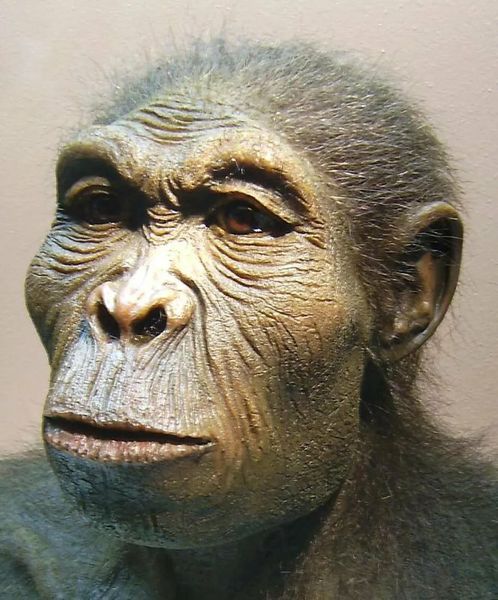
Not really? And imagine what your beloved woman or your beloved man would look like! The fact is that modern men and women have clear concepts of the beauty and attractiveness of the sexual partner, they are fundamentally different from those of primates. For example, smooth skin, a slender figure, a woman’s lush chest, slender long legs, which from my point of view is evolutionarily completely unjustified. If the appearance and hairline changed gradually, as we are told, for example, under the influence of savannah heat, then in terms of beauty, sympathy for hairy women in men and men in women would have to be rudimentarily preserved. Instead, they are repulsive! A legitimate suspicion arises, as if the Cro-Magnon, that is, the ancestor of homo sapiens, appeared just like that, immediately ready-made. But it did not evolve gradually from the distant ancestor shown in the figure. At the same time, for example, it is completely unclear to me how this is so. Naked, barefoot, completely defenseless. In the savannah? How could he become so? It turns out that he immediately had to find some kind of clothes and wrap his feet so as not to get hurt. Those who walk barefoot know that the slightest wound can easily rot and turn into gangrene. The hairline provided at least a small, but protection. From the cold, for example.
In general, I have serious doubts about how the Cro-Magnons lived in prehistoric times. They had nothing, nothing to make clothes with, and nothing to wear. It's unlikely they could have carved even a tool from the first stone they came across, using just another stone. There was nothing to make a fire with, and such technology didn't exist. There was nothing to build a shelter from. This is the same problem that characterizes the entire theory of evolution: the initial period cannot be explained in a normal way. We are told that the Cro-Magnons evolved from ancestors who gradually lost their hair, but in such a situation, why bother? At least body hair provided protection. Continued hair loss will only make matters worse.
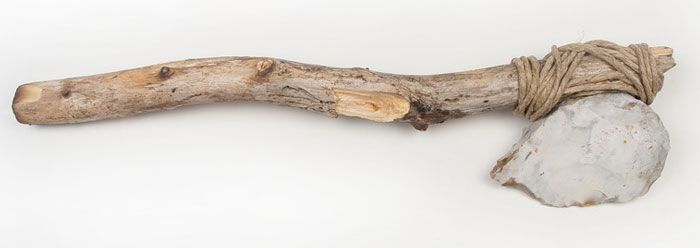
Even the entire Corded Ware culture is otherwise known as the Battle Axe Culture. But in practice, such axes perform poorly. In prehistoric times, there wasn't even rope to tie the stone blade to the handle. If you tie the blade sideways, the axe would twist when struck. If you insert the blade into a split in the handle, it would break the wooden stick and fly out. Inserting the blade into a hollow gouged out in the handle is too complex to craft with crude stone tools. Stone axes with a hole for attaching the handle are highly questionable. Such a smooth hole can only be made with a modern, specialized stone drill, and on a drilling machine at that. As far as I can tell, these are either fakes, or the manufacturing dates are incorrect.
This means that stone axes weren't fully functional tools. They were used either for self-defense or for hunting small animals. Cutting down a tree with such an axe, or even lopping off a thick branch, is extremely difficult. The same applies to spearheads and bow arrows.
The same goes for bronze. People had to understand that copper could be extracted from ore, such as malachite, and used to make useful things. Malachite also had to be mined. Tin is also rare, and it needed to be extracted from the rock. After that, they had to understand that a copper-tin alloy is stronger and better than pure copper. It's hard to imagine that, without any analogs to this process, people learned to do it themselves. Without the help of those who already knew how. And who first learned it themselves, without anything else or the opinions of others, in a primitive culture and with the simplest tools, remains a mystery.
A sad conclusion emerges. The initial stage of Homo sapiens' emergence is marked by a vast gap that we cannot describe. How our distant ancestors lived then is completely unclear.
Criticizing modern evolutionary theory would be a very long essay. There are probably millions of similar examples. The situation is simple. There's a spider and there's a grasshopper. They're two different creatures, but they live side by side in the same habitat. According to modern evolutionary theory, they must have a common ancestor. But evolutionary theory can't answer the simple question of why, at a certain point, it diverged into two fundamentally different species of insects, and that's where it stops.
No, I do not want to say that someone led the entire evolution on Earth. Although I do not exclude this. Mass extinctions are already very suspicious. But not necessarily. It is quite easy that extinction could happen under the influence of natural disasters. But when you see sharp inexplicable leaps in development that do not fit into any theory, it is quite possible to assume external intervention.
THINK BEFORE OBJECTING. AND WHY THIS COULD NOT HAPPEN?
What's so unscientific about this point of view? What could have prevented it? Is our planet under an impenetrable cap? Is it impossible to reach it by starship? Yes, archaeology has found no evidence of alien presence on our planet. But this only means they left no traces. It doesn't necessarily mean they were here themselves. Whether aliens ever landed on our planet is unknown. But as it turns out, they bred beautiful species here simply for pleasure, remotely, using some unknown machine. This is how those inexplicable leaps in evolution occurred, leading to the emergence of fundamentally new species, radically different from their ancestors. Meanwhile, the evolution of species proceeded in parallel. Whether other intelligent beings, more advanced than the Cro-Magnons, ever appeared on our planet is also unknown.
So, it's entirely possible that modern humans were created by aliens, repurposed from some ancestor; we now know that such a hypothesis has solid grounds. It's also possible that all other hominids were unsuccessful attempts and therefore died out, or were killed by a built-in combat biorobot that wasn't yet fully developed. Cro-Magnons also experienced a developmental bottleneck, approximately 50,000 years ago, when species numbers plummeted to near their lowest point. It's quite possible that we were further modified at that time to curb our overly rapid evolution.
RATHER, HOMO SAPIENS MADE BY GENETIC MODIFICATION OF THE MONKEY ANCESTOR. AT THE SAME TIME, A FACTOR WAS BUILT INTO IT, WHICH IMPEDED ITS DEVELOPMENT.
So it becomes immediately clear how it developed that confuses anthropologists in the evolution of the human species.